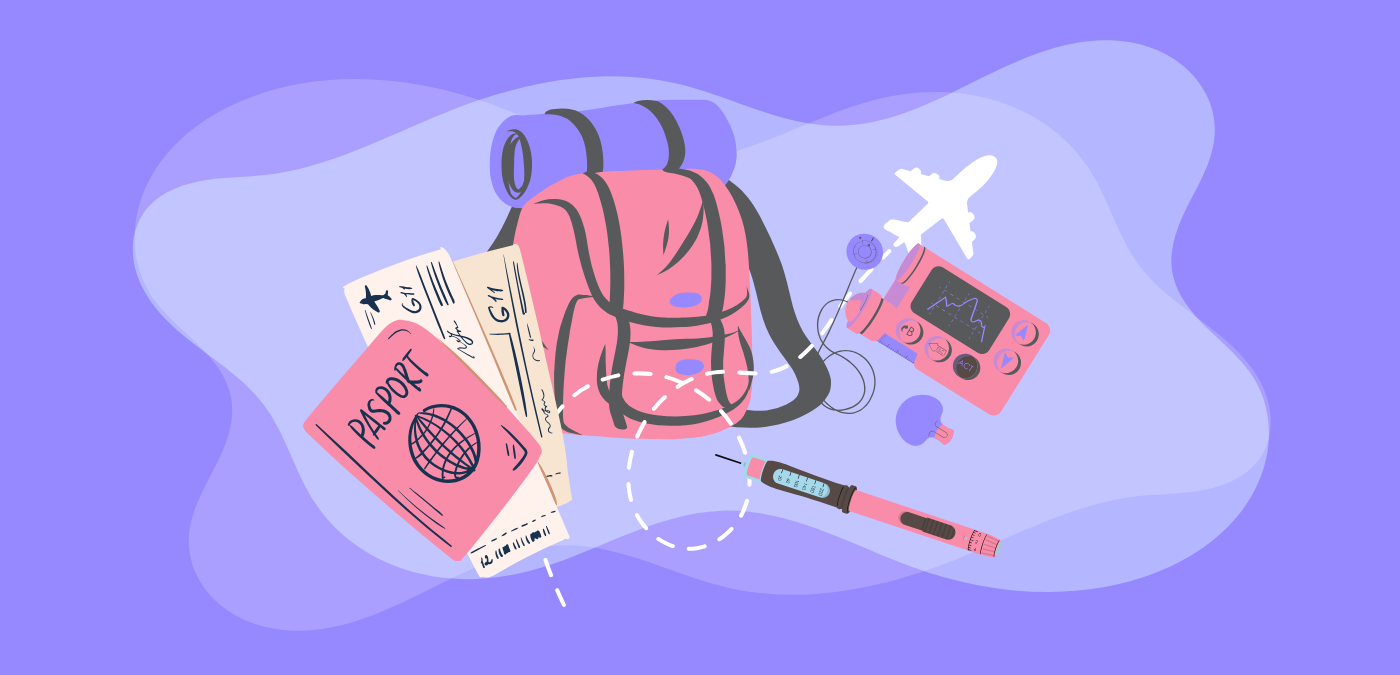
Planning a trip is exciting! Traveling is often associated with holidays and enjoyment, and living with type 1 diabetes (T1D) shouldn’t change that. That said, there’s no doubt you’re travelling with extra baggage—both literally and figuratively. With good preparation, you can approach each step of your journey with confidence.
Whether your trip is going to be active (e.g., biking), work-related (e.g., at a conference) or relaxing (e.g., at the beach), it’s important to prepare well to avoid unpleasant surprises. Any changes in your routine, delayed meals, jet lag, temperature differences, and change in physical activity can disrupt blood sugar management.
Plan ahead
Once the trip is booked, you have to start planning with T1D in mind. Consider the following:
- Consult your healthcare team 4 to 6 weeks before departure to obtain a travel letter justifying the transport of medical supplies. Examples of letters in English, Spanish, French, Italian, and Mandarin.
- Ask your pharmacist to print out a list of your medications and the supplies you need to manage your diabetes.
- Check your insurance coverage for the duration of your trip (e.g., emergency medical expenses, repatriation expenses).
- Bring enough supplies (ideally double what you need to face any possible unforeseen events). Keep in mind that the treatments and supplies you use may not be available in the country where you’re going.
- Wear medical ID (e.g., MedicAlert® bracelet).
- Identify the nearest hospital at your destination in case of emergency.
- Bring a rehydration drink (e.g., Gastrolyte) in case of illness.
- Consider bringing a needle cutter to safely dispose of used needles. Once cut, syringes or pen needles can be disposed of in regular waste.
If you use an insulin pump or hybrid closed-loop system (also known as an “artificial pancreas”):
- Ask your pump company to lend you one for the trip. This extra pump is a safety measure in case of pump breakage during the trip.
- Make sure you can easily find your pump settings (e.g., by writing them down on a sheet of paper, taking a picture, or saving them online) in the event of a breakdown.
- Make sure you bring the Pump Back Up Plan in the Event of Insulin Pump Failure and that you take both rapid- and long-acting insulin with you (ask your doctor for a prescription) as well as the necessary injection supplies. This is your backup solution in case of a pump failure (and if no spare pump is available).
HANDY TIP:
Check out our lists that summarize what essential supplies you need to pack if you administer your insulin with injections or an insulin pump.
Flying
If you’re getting ready to fly, here are some recommendations:
- If you’re travelling by air with an insulin pump and/or continuous glucose monitoring (CGM) device, you can keep them on when going through the metal detector. However, these devices must not be exposed to X-rays from the full-body scanner and carry-on luggage conveyor belt. You can tell the agent that you wear diabetes management devices and prefer a pat-down search.
- Keep all your medical supplies and insulin in your carry-on luggage. Not only will it protect the insulin from freezing in the hold, but it will also ensure that you have the necessary equipment with you in case your luggage is lost. For example, you could carry your insulin in a pouch that keeps the insulin cool to minimize temperature fluctuations (e.g., FRIOⓇ, GlucologyTM, Breezy packs).
- Keep your emergency kit with you at all times (e.g., nasal glucagon, snacks for low blood sugar).
How to deal with jet lag?
The effects of jet lag can vary depending on its extent. If the time difference is more than three hours, jet lag can affect your internal clock and cause tiredness, insomnia, irritability or changes in appetite. These symptoms vary from one person to another. In the first few days, insulin sensitivity can also change and cause glycemic imbalance despite dosage adjustments.
If there is a time difference between your destination and departure point, consider adjusting the time on your blood sugar management devices. You might also have to adjust insulin doses.
- If you’re using an insulin pump, you don’t need to make any adjustments. Some newer automated insulin delivery systems systems (e.g., next-generation artificial pancreas systems) may automatically update the time. Otherwise, adjust the time manually upon arrival.
- If you inject your insulin with pens or syringes, you may need to adjust your long-acting insulin dosage on departure day and the day you return if the time difference is greater than three hours.
- Traveling east: the travel day will be shorter, so you’ll need to decrease your dosage.
- Travelling west: the travel day will be longer, so you’ll need to increase your dosage.
See how to change your long-acting insulin dosage according to the type of insulin you use:
- Intermediate-acting insulin (e.g., NPH, Humulin N): increase or decrease the dose by 10% (of the daily total number of units of rapid- and long-acting insulin) for every three-hour period of time difference.
- Long-acting insulin with a 24-hour duration of action (e.g., Lantus, Levemir, Basaglar): increase or decrease the insulin dose by 4% (of the total long-acting dose) for each hour of time difference.
- Long-acting insulin with a duration of action greater than 24 hours (e.g., Toujeo, Tresiba): no adjustment required.
- Weekly insulin (AWIQLI/icodec): no adjustment expected, but discuss with your care team before travel due to limited data.
If in doubt, don’t hesitate to ask your healthcare team for help when you meet with them before your departure. They can help you determine the best strategy to follow.
To go further
To go further, log in to Support and explore the course All About Preparing for a Trip, which helps answer common questions about travelling with T1D, including how to prepare before departure, manage insulin and supplies, travel abroad, adjust for time zone changes, and handle diabetes management in case of illness or unexpected situations.
Access Support to explore the course and all available resources.
As you can see, planning is the key to a successful trip, especially when living with T1D. Have a good trip!
(First published: February 2023. Updated: May 2026.)
References :
- Module « Se préparer pour un voyage », Plateforme de formation en ligne Support
- Diabète Québec, Planifier son voyage, consulté le 25 janvier 2023, https://www.diabete.qc.ca/fr/comprendre-le-diabete/pratique/voyages/planifier-son-voyage/
- Unité de médecine de jour métabolique de l’Hôtel-Dieu du CHUM. (2013). Connaître son diabète pour mieux vivre. Montréal : Les Éditions Rogers limitée, Groupe santé.
Written by: Sarah Haag RN. BSc.
Reviewed by:
- Amélie Roy-Fleming Dt.P., EAD, M.Sc.
- Anne-Sophie Brazeau RD, Ph. D.
- Aude Bandini, Claude Laforest, Jacques Pelletier, Eve Poirier, Sonia Fontaine, Nathalie Kinnard, Laurence Secours, Michel Dostie, Marie-Christine Payette, patient-partners of the BETTER project
Linguistic revision by: Marie-Christine Payette